Finding the best Azul Macaubas Quartzite in China requires more than comparing online prices. Buyers need verified suppliers, consistent quality, and practical knowledge of natural stone. This guide examines where to source premium slabs and how to judge a trustworthy Chinese exporter.
Karin Kirk, a geologist and natural-stone educator, offers a useful reminder: “Natural stone is a product of nature, so no two slabs are exactly alike.” That principle matters when evaluating Azul Macaubas Quartzite. Each block may display different blue movement, white veining, and golden mineral accents. A polished sample can look impressive under showroom lights. It may appear different beside a kitchen window.
Experienced buyers should request recent slab photographs and full-resolution videos. Ask for the block number, quarry origin, thickness, finish, and available dimensions. Reliable suppliers should also provide water-absorption data, flexural-strength results, and inspection records. Independent testing is worth considering for large commercial projects.
Do not trust the word “best” too quickly. It is a marketing claim, not a technical grade. Some suppliers offer beautiful material but weak packaging or unclear replacement policies. Others communicate well but have limited stock. I have found that small details often expose larger risks. Check crate construction, edge protection, loading photos, and shipping terms before payment.
This introduction will compare Chinese stone manufacturers, wholesale markets, and direct-export suppliers. It will also explain how to compare quotations fairly. Freight, crating, polishing, taxes, and port charges can change the final cost significantly. The goal is simple: help buyers choose authentic Azul Macaubas Quartzite with clearer evidence and fewer expensive surprises.
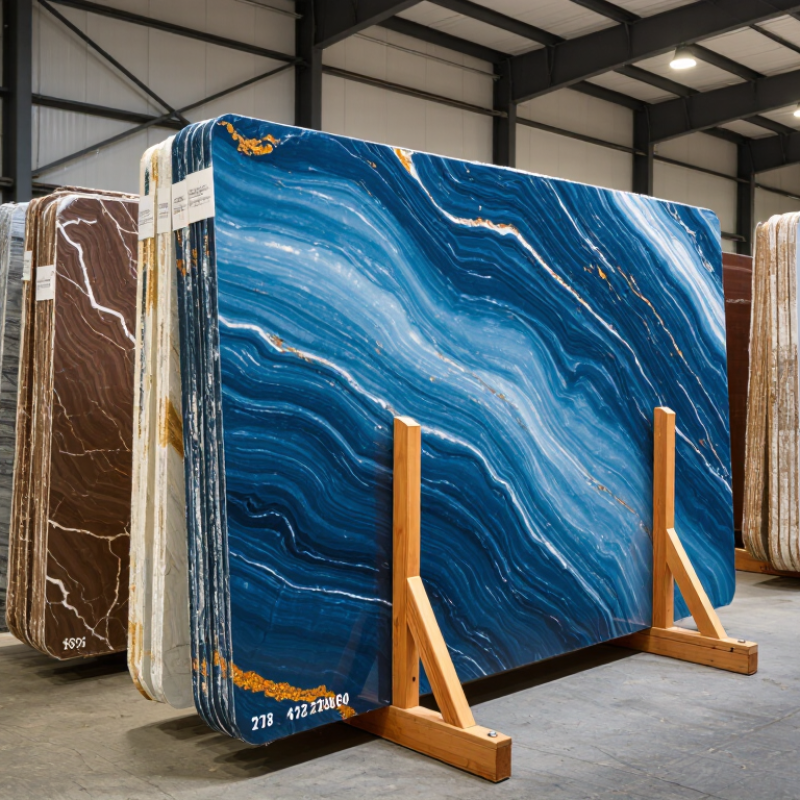
Azul Macaubas quartzite is a natural stone known for blue backgrounds, white movement, and occasional gray mineral clouds. Its color usually comes from mineral inclusions, often associated with dumortierite, but each quarry block can differ. That variation creates genuine character. It also makes online photographs unreliable.
Quartzite forms under intense heat and pressure, so it is generally harder than marble. However, it is not stain-proof or maintenance-free. Surface finish, resin treatment, and slab quality affect performance. The U.S. Geological Survey’s 2024 Dimension Stone summary confirms that imported stone remains important in the American market. This helps explain why buyers should request quarry origin and technical documentation before purchasing.
Market interest is also measurable. Grand View Research estimated the global natural stone market at about 50 billion dollars in 2023, with annual growth near 4.9% through 2030. Azul Macaubas benefits from this wider demand for distinctive natural surfaces. Still, popularity can encourage rushed buying. Inspect full slabs at a professional stone warehouse, not only small samples. Ask for water absorption, flexural strength, and abrasion data. Check repaired fissures under direct light. Slight color differences are normal. Dramatic defects are not. A qualified fabricator should also review vein direction, edge details, and support requirements before cutting.
When evaluating Chinese Azul Macaubas quartzite, inspect more than its blue color. Natural Stone Institute guidance recommends reviewing the stone’s intended use, finish, absorption, and strength together. A bright slab is not automatically a durable slab.
Request a recent laboratory report for the same quarry lot. The report should identify water absorption and bulk specific gravity under ASTM C97. It should also include compressive strength under ASTM C170 and flexural strength under ASTM C880. ASTM C616 provides specification guidance for quartz-based dimension stone. Compare these results with the project engineer’s requirements, not with attractive showroom claims. Test results matter.
Check the slab edges and back carefully. Hairline cracks, resin-filled voids, uneven mesh, or cloudy patches may appear after polishing. Hold a sample under angled light. The surface should remain consistent, though natural movement will never be perfectly uniform. That is acceptable. Poor calibration is not. Ask for photos of full slabs, not only close-ups. Confirm thickness measurements at several points. Small variation can complicate installation. I would also request an extra sample from the delivered batch; colors can shift between lots. This step is often skipped. That is a mistake. A 2024 technical review from the Natural Stone Institute emphasizes project-specific testing and documented stone performance, supporting a cautious, evidence-based purchase decision.
Finding reliable Azul Macaubas quartzite suppliers in China requires more than comparing online prices. Look for suppliers with documented quarry sources, stable processing facilities, and experienced export teams. A dependable supplier should explain whether the material is sourced as blocks or purchased from another channel. This detail affects color consistency, slab thickness, and production control.
Request recent photos, videos, and physical samples from the same batch. Photos are not enough. Examine blue tones, quartz patterns, fissures, filled areas, and surface finishing under natural light. Ask for evidence of water absorption, thickness tolerance, and polishing quality. A professional supplier should provide inspection records without avoiding technical questions. Factory visits or independent inspections can also confirm cutting equipment, storage conditions, and packing methods.
Reliable exporters usually use reinforced wooden crates, moisture protection, and clear slab labels. Confirm the number of slabs, usable dimensions, finish, and replacement terms before placing an order. Payment schedules should match production milestones, not vague promises.
Be careful with unusually low quotations; they may hide lower grades or inconsistent thickness. No checklist is perfect. Even careful buyers can miss variation between sample and shipment. Keep written approvals, batch images, and signed specifications. Small details matter.
Before ordering Azul Macaubas Quartzite from China, verify its quarry origin. China may cut, polish, reinforce, and package Brazilian material, but fabrication country is not quarry country. The 2024 U.S. Geological Survey Mineral Commodity Summaries tracks dimension stone by production, imports, and exports. This supports checking both origin and supply-chain documents. Request block numbers, quarry details, recent slab photos, and packing-list records. Photos should show full slabs, not only attractive corners.
Ask for independent test results before paying a deposit. ASTM C97 measures absorption and density. ASTM C170 evaluates compressive strength, while ASTM C880 tests flexural strength. These tests matter for countertops, wall panels, and flooring. A reliable supplier should provide sample identification and testing dates. Compare the report with the actual slab. Sometimes, the paperwork looks perfect, but the stone does not.
Tips: Request a small physical sample first. Wipe it with water and inspect darkening after ten minutes. Check resin-filled cracks, edge repairs, thickness tolerance, and vein direction. Confirm whether bookmatching is possible. Natural variation is expected, but heavy filling may affect appearance and maintenance. The Natural Stone Institute’s technical guidance also stresses project-specific testing, especially when stone faces moisture or structural loads. I would not approve a large order from photographs alone. One overlooked vein can change the entire installation.
Where to Buy China Best Azul Macaubas Quartzite?
Comparing Azul Macaubas quartzite suppliers requires more than checking the lowest slab price. Ask for the exact grade, thickness, surface finish, slab dimensions, and production batch. A polished 20-millimeter slab may look affordable until edge processing and wooden crating are added. Request recent photos under natural light. Computer-enhanced images can hide veins, resin marks, or uneven coloring.
Shipping changes the real cost. Compare the complete delivered price, including inland transport, port charges, export documents, insurance, and destination fees. Confirm the loading port and estimated transit time in writing. Inspect the crate design carefully; strong corner protection matters when slabs travel long distances. A pre-shipment inspection can verify quantity, dimensions, finish, and visible damage. It costs extra, but replacing broken stone costs more.
Supplier service also deserves a practical test. Send the same questions to several factories and compare response accuracy, not just speed. Reliable suppliers should provide test data, packing photos, commercial documents, and a clear claim process. Ask whether replacement slabs come from the same batch. I once compared only the square-meter price and overlooked crating fees. That mistake was expensive. Do not assume every “premium” grade is consistent; request a physical sample before placing a large order. Even then, natural stone varies. Allow a realistic tolerance for color and veining.
| Comparison Dimension | Typical Market Information | What to Check Before Ordering | Buyer Evaluation |
|---|---|---|---|
| Material classification | Azul Macaubas is a natural blue quartzite. Color, veining, crystal structure, and background tone vary from block to block. | Request current slab photographs, a continuous slab video, and the quarry or block reference when available. | High importance: visual variation is normal and should be confirmed before payment. |
| Common slab thickness | Approximately 18–20 mm for standard slabs; approximately 30 mm for thicker premium applications. Actual thickness may vary after polishing. | Confirm finished thickness, allowable tolerance, edge-processing allowance, and whether reinforcement is included. | Compare like-for-like thickness rather than comparing only the quoted square-foot price. |
| Indicative material price | Export material prices commonly vary from about USD 80–180 per square foot for selected slabs, depending on grade, size, color, and availability. | Ask whether the price is per slab, square meter, or square foot, and whether crates, polishing, export packing, and documentation are included. | Use the total delivered cost, not the lowest initial quotation. |
| Slab size and usable yield | Large-format slabs are often approximately 2600–3300 mm long and 1400–2000 mm wide, but sizes depend on the block and production process. | Obtain exact slab dimensions, net usable area, cutout limitations, and digital layout drawings. | A slightly higher-priced slab may reduce seams and material waste. |
| Surface finish | Polished is the most common finish. Honed, leathered, and other finishes may be available but can change lead time and price. | Confirm gloss level, sample approval, finish consistency, and whether the selected finish is suitable for the intended application. | Require a physical or high-resolution finish sample for large projects. |
| Export packaging | Sea-freight slabs are normally packed in fumigated or compliant wooden A-frame crates with separators and protective materials. | Confirm crate dimensions, crate treatment certification, moisture protection, corner protection, and loading photographs. | Strong packaging reduces breakage risk but may increase freight volume and cost. |
| Shipping method | Full-container sea freight is generally more economical for multiple slabs. Less-than-container-load shipping may suit small orders but often has higher handling risk and cost per unit. | Compare FOB, CIF, and DDP quotations and identify the exact destination port or delivery address. | The same Incoterm must be used when comparing different suppliers. |
| Indicative ocean transit | Port-to-port transit is often about 25–55 days, depending on origin, destination, transshipment, season, and carrier schedule. | Request production time, vessel schedule, transshipment details, customs time, and estimated last-mile delivery time separately. | Treat transit estimates as schedules rather than guaranteed arrival dates. |
| Freight and destination charges | Total logistics cost can include ocean freight, terminal handling, customs clearance, duties, inspection, storage, delivery, and unloading equipment. | Request an itemized landed-cost sheet and confirm who pays demurrage, storage, port fees, taxes, and delivery surcharges. | A transparent cost breakdown is more valuable than an unusually low freight estimate. |
| Minimum order quantity | One or two slabs may be accepted by some exporters, while better pricing is usually available for grouped orders or a full container. | Confirm minimum slab quantity, mixed-container rules, inspection fees, and whether small-order handling charges apply. | Small orders should be compared on delivered cost per usable square foot. |
| Quality inspection | Inspection may cover cracks, resin filling, repairs, thickness, flatness, polish, dimensions, and color consistency. | Use an agreed inspection checklist and define acceptable natural features before production or loading. | Independent pre-shipment inspection is useful for high-value or large-volume orders. |
| Documentation | Typical documents may include commercial invoice, packing list, bill of lading, origin documentation, and fumigation or wood-packaging records where required. | Confirm document format, consignee information, customs requirements, and the time documents will be released. | Missing or inconsistent documents can delay clearance even when the stone arrives safely. |
| Payment terms | Common arrangements include a deposit before production and the balance before shipment; exact terms depend on order size and supplier history. | Match the payment schedule to inspection, slab approval, packing completion, and release of shipping documents. | Avoid paying the full amount before confirming the selected slabs and packing condition. |
| After-sales support | Useful support may include replacement discussion, damage reporting, installation guidance, technical documents, and claims handling. | Put claim deadlines, evidence requirements, responsibility for transport damage, and remedy options in writing. | Clear written procedures are a stronger indicator than verbal promises. |
| Best-value buying approach | The best purchase balances slab appearance, usable yield, quality control, packaging, delivery reliability, and total landed cost. | Collect comparable quotations using the same thickness, finish, quantity, destination, Incoterm, and inspection standard. | Choose the supplier with the clearest specifications and lowest risk-adjusted delivered cost—not simply the lowest quoted price. |
Note: Price, freight, transit time, slab availability, and import charges are indicative market ranges and should be reconfirmed with a current written quotation for the specific destination and project quantity.