Choosing a reliable Seamless Pipe manufacturer in China requires more than comparing price lists. Buyers should examine production capability, material traceability, inspection practices, and delivery performance. A polished catalog is not proof of consistent quality. Ask whether the supplier operates its own mills or sources from other producers, and request clear documentation for the specific order.
This overview considers manufacturers through practical factors: available steel grades, outside diameters, wall thicknesses, heat-treatment options, and export experience. It also highlights quality checks that matter in real projects, including dimensional inspection, hydrostatic testing, and ultrasonic examination where applicable. Details such as heat numbers and mill test certificates can help buyers connect delivered pipes with production records. Small details matter.
“Top” depends on the application. A supplier suited to construction work may not fit a demanding energy project, while a large production capacity alone does not guarantee a good match. Buyers should confirm current certifications, sample documents, production schedules, and inspection arrangements directly with each company. Specifications and capabilities can change, so this article is a starting point, not a substitute for supplier verification. There is room for doubt: published claims may not show how consistently a factory performs across different orders. The strongest choice is the manufacturer whose documented capabilities match the project’s requirements.
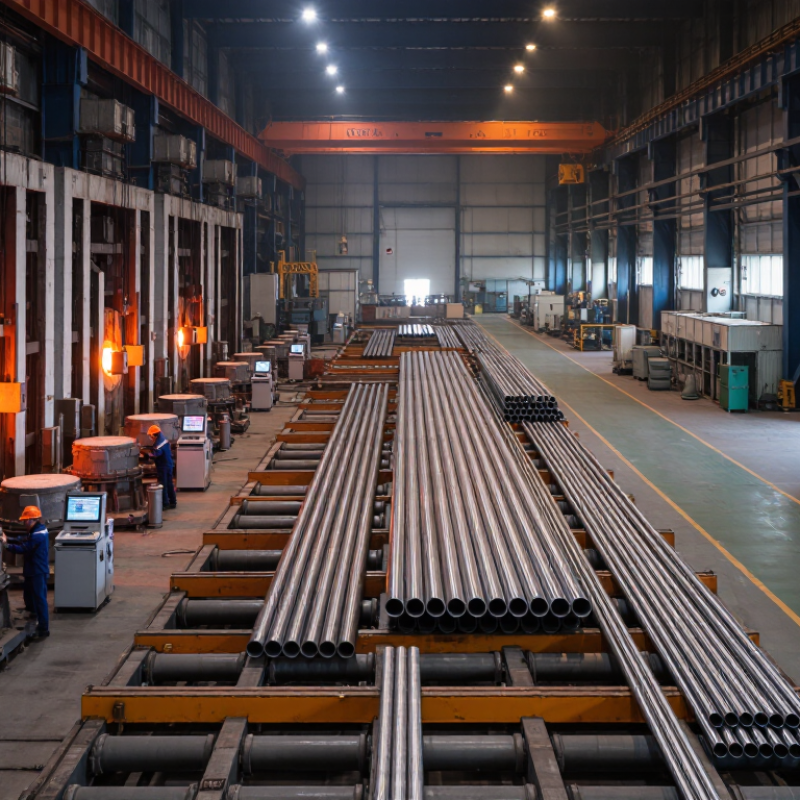
Seamless pipe is made from a solid steel billet, not a rolled strip joined by a weld. The billet is heated until workable, then pierced by rotating skew rolls and a plug to create a hollow shell. The shell is elongated, rolled to its target diameter and wall thickness, and sized. That distinction matters.
World Steel Association’s World Steel in Figures 2024 reports that China produced 1,019.1 million tonnes of crude steel in 2023; global production was 1,892.2 million tonnes. These figures describe crude steel, not seamless pipe output, so they show the scale of the upstream supply base rather than pipe capacity.
After rolling, manufacturers may cool, heat-treat, straighten, and cut the pipe to length. Inspection can include ultrasonic testing, eddy-current testing, and hydrostatic testing, depending on the product specification. A smooth outside is not proof of a sound inner wall.
Inspectors check dimensions and test results against the applicable standard and order requirements. Small process differences matter: heating time, piercing alignment, and cooling rate can affect wall uniformity and mechanical properties. Even a well-controlled line needs careful checks; the process is not flawless by default.
China’s seamless pipe industry developed alongside the country’s expansion in energy, construction, and heavy manufacturing. Early mills concentrated on supplying basic grades for domestic projects. As demand grew, producers invested in larger furnaces, piercing equipment, and more controlled rolling processes. The shift was gradual, not perfectly even. Some facilities modernized faster than others.
Process control became a major part of this change. Modern production lines can monitor heating temperatures, wall thickness, and pipe dimensions more closely. Non-destructive testing also helps identify internal flaws before pipes reach demanding applications. Better measurement matters. A small variation in wall thickness can affect how a pipe performs under pressure. Still, equipment alone cannot ensure consistency; skilled operators and reliable inspection routines remain essential.
The product range has broadened from common structural and fluid-transport pipes to grades used in oil and gas, power generation, and machinery. Producers have also adapted to stricter customer specifications and international quality requirements. This progress has brought challenges: raw-material costs fluctuate, and high-end grades require steady process discipline. China’s industry continues to invest in automation and quality systems, while mills work to reduce energy use and maintain dependable output.
China’s leading seamless pipe manufacturers are difficult to rank from public data alone. Many industry tables report crude steel output, not seamless-pipe capacity, product quality, or delivery performance. The World Steel Association reported that China produced 1,005.1 million tonnes of crude steel in 2024, down 1.7% from 2023. That shows the scale of China’s steel sector, but it does not identify the top pipe producers. A ranking needs closer checks.
Strong candidates generally fall into three groups: integrated mills with control over steelmaking and pipe production, specialist plants focused on particular grades or dimensions, and export-oriented manufacturers serving energy and industrial projects. Buyers can compare actual production routes, heat-treatment facilities, ultrasonic or electromagnetic inspection, and traceable test certificates. For oil and gas orders, confirm relevant API specifications and verify that the certified scope matches the exact product. Look closely at wall-thickness tolerances and delivery records, too. Paper credentials are not the whole story. A useful comparison should include recent mill audits and sample inspection records; these details are easy to overlook, and public information can be incomplete.
Chinese seamless pipe manufacturers produce hot-finished and cold-drawn tubes in carbon, alloy, and stainless steel grades. Common products include pressure tubes, mechanical tubing, and pipes for fluid transport. Wall thickness, outside diameter, and surface finish vary by production route. A smooth bore matters in some services; dimensional consistency matters in others.
These products serve power generation, petrochemical processing, oil and gas, machinery, construction, and transportation. Boiler tubes must withstand heat and pressure. Mechanical tubes may be cut, bent, or machined into components. Pipeline applications call for suitable strength and corrosion resistance. Seamless construction removes a welded joint, but it does not make every pipe suitable for every duty.
Selection depends on operating pressure, temperature, media, and project specifications. Buyers should review material certificates, heat numbers, dimensional tolerances, and inspection records. Non-destructive testing may also be required. A catalog can look comprehensive, yet leave important details unclear. Confirm the exact grade and testing scope before ordering; small differences can affect fabrication and service life.
A credible comparison starts with the actual service conditions: grade, outside diameter, wall thickness, length, temperature, and working pressure. China’s scale is substantial: World Steel Association data put its 2023 crude steel output at about 1.02 billion tonnes. That figure signals industrial capacity, not seamless-pipe quality. Buyers still need evidence from the specific mill and production route.
Ask for traceable inspection records linking each pipe heat number to its material test certificate. Check chemistry, tensile results, dimensional tolerances, and non-destructive testing against the purchase specification. For pressure service, confirm the stated test method and acceptance criteria; do not assume every mill uses the same inspection scope. Request recent, relevant test records, not only a polished sample certificate. Small detail, big difference.
Compare production range and delivery performance using the same specification and order quantity. Ask whether piercing, heat treatment, finishing, and testing are performed in-house or subcontracted. An independent audit can verify equipment, calibration, and record control, while a witnessed inspection can expose gaps before shipment. OECD steel-capacity reporting also cautions that broad industry capacity figures do not prove a supplier can meet a particular order on time. I would still check references and lead-time history; paperwork alone can miss real production bottlenecks.